


The building materials market is undergoing profound changes. Emerging markets are becoming urbanized and experiencing unprecedented growth. People are also becoming increasingly aware of environmental issues and new building methods.
An overview of the challenges faced by the sector around the world.
Understanding the industry |
|
|
The cement industry provides materials used in the construction of homes, other buildings and infrastructure. The most widely used of these materials is concrete (made from cement and aggregates) which is used in situations ranging from foundations for roads through to structural elements in very large and complex buildings.
Demand for cement worldwide is strongly linked with population growth, urbanization, and economic growth. The generally accepted projection of global growth in demand for cement through to 2025 is that it will continue to grow by an average 5% a year to around 4.7 billion tonnes. The demand for more elaborate and complex buildings and the desire for more sustainable construction have stimulated the industry to produce many different types of cement suitable for different purposes. |
2020 cement consumption (estimate in %) |
Cement in Greece |
|
|
Although the rest of the world began to recover from recession in 2010, Greece did not. The austerity measures required by the European Commission and the International Monetary Fund affected demand for new houses and infrastructure. Domestic demand for cement dropped to six million metric tons in 2010, compared to the peak of 12 million tons in 2007. This created very difficult conditions for Heracles and we believe these conditions will continue into 2011.
In the medium term however, we believe there is a stable domestic market for cement which is larger than that which exists at present. Our strategy is primarily to address the needs of that market and more marginally to look for exports as long as they bring profitability to our company. |
|
Moving towards new industrial practices |
|
|
Cost structure In general, the cost of manufacturing our different products can be broken down as follows:
Reducing the environmental footprint of our activities
The cement making process necessarily entails the release of carbon dioxide: 60% of emissions are due to the transformation of raw materials at high temperatures (decarbonation of limestone), and 40% result from the combustion needed to heat the cement kilns to 1500°C. Since the 1970s, the Lafarge Group has been working to reduce its ecological footprint in order to respond to needs for infrastructure, housing, hospitals and schools while conserving natural resources.
This approach focuses on:
Towards sustainable construction The building consumes vast amounts of energy and is the source of 40% of the CO2 emissions of developed countries.
Lafarge is working to invent the building methods of tomorrow. The entire life cycle of the building needs to be reconsidered, from the use of recyclable materials to the integration of renewable energies and the reduction of pollution. |
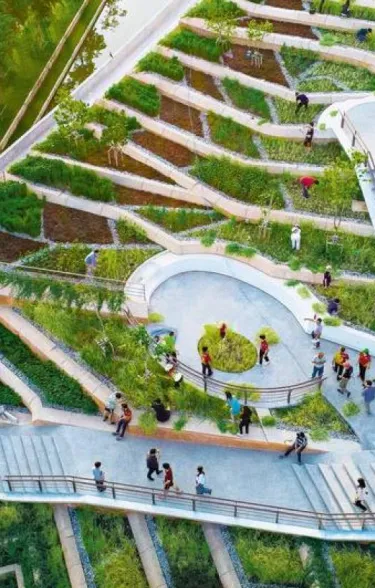
Sustainable constructionSustainable construction aims to limit the impact of buildings on the environment while enhancing their quality in terms of aesthetics, sustainability, durability and strength. Sustainable construction techniques apply across the entire life cycle of a building, from the selection of initial materials to demolition and recycling. |
Last update on 29/07/2011