
Lafarge develops and is implementing a comprehensive climate change strategy. The Group surpassed its 2010 objectives 1 year in advance and set itself 3 new targets for 2015 and 2020, in the framework of its partnership with WWF.
Reducing CO2 emissions |
|
|
Lafarge is aware of challenge which climate change presents for the entire planet. Since 2001, the Group committed itself to ambitious objectives in the framework of a pioneering partnership with WWF. Lafarge has fulfilled and surpassed in advance its 2010 objectives. Specifically:
(* Gross/net emissions: net emissions equal gross emissions minus emissions related to the burning of waste.)
Going beyond plants
The construction sector accounts for 40% of the global energy demand, and for 30% of the overall greenhouse gas emissions.
In 2011, the Group announced it 2nd generation commitments, set up in the framework of the partnership with WWF International. Lafarge's 3 new targets for 2015 and 2020 are in line with a comprehensive, ambitious and original approach. They go beyond plants CO2 emissions and encapsulate the entire construction chain:
Relying on industrial ecology and innovation
To meet these objectives, the Group is:
Lafarge also invests in research to:
|
CO2 and cementWhy does manufacturing cement produce CO2? Cement manufacturing is the source of 5% of global carbon dioxide (CO2) emissions. The cement making process necessarily entails the release of carbon dioxide:
Kyoto ProtocolThe Kyoto Protocol aims to counter climate change by reducing carbon dioxide emissions. In effect since February 2005, it has been ratified by over 150 countries but has not been ratified by the United States for example.
Under the Protocol, industrialized countries have until 2012 to reduce their CO2 emissions by 5.2% compared to 1990 levels. |
Our commitment and carbon reduction in Greece |
|
|
Sustainability Ambitions 2012 set targets for carbon reduction. In 2009, we out-performed our targeted reduction in CO2 emissions per metric ton of cement; we achieved a 12.8% reduction while the target was 11% (compared to 1990 levels). We were not able to sustain this reduction in 2010; the reduction was 8.34%. This was largely the result of a shift in our customers' requirements in the current economic context; there was increased demand for high strength cement with a high proportion of clinker. There was a decline in total emissions as a consequence of market conditions in Greece in 2010.
We are taking multiple routes to reducing the emissions associated with cement manufacture. Burning fossil fuels to produce clinker (from which cement is manufactured) produces CO2, so optimizing the combustion process and other types of energy efficiency reduce emissions, as does replacing fossil fuels with renewable or other alternatives. Thirdly, there is product innovation; the use of cement additives which are CO2 neutral, allow us to develop products that have a lower CO2 footprint.
Alternative raw materials Since 1980, we have been using alternative raw materials that can substitute clinker in the cement. This is a more positive environmental option. We now use a wide variety of alternative materials: fly ash, blast furnace and other forms of slag, iron mill scale, red mud, waste bauxite, pyrite ash and chemical gypsum. In 2010, the use of alternative raw materials remained more or less at the same level as in 2009 (10.20%).
Alternative fuels A significant contributor to our success in CO2 reduction has been the use of biomass as a fuel in substitution of fossil fuels. A new facility was initiated at the Volos Plant and started operation in May 2008. In 2010, biomass accounted for almost 1% of the fuel used in our plants in total.
Biomass, mostly cotton and corn stems, is delivered to the plant in bales and stored in a covered area in order to be then processed and be fed to the kiln. Total installed power amounts to approximately 300 KW. This is the culmination of a long-term project initiated in 2005. The use of locally produced biomass adds to the economic prosperity of the region.
In strategic terms, we see potential in the use of fuel derived from the residue of municipal waste recycling called solid shredded waste (SSW).
|
Kiln at Volos plant Biomass used at Volos plant New Athlos productA real breakthrough in 2009 was the development of Athlos new bagged product. Beyond the fact that Athlos changed the paradigm, creating a niche market for masonry cements, its production releases per ton of cement approximately 65Kg less carbon dioxide compared to the former, conventional product. Transport emissions
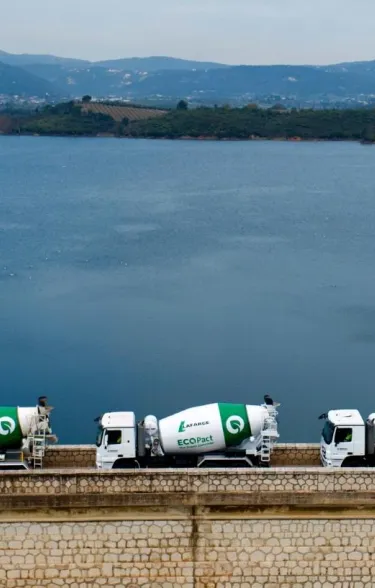
Using a special program (Trucks Control System, TCS) the Logistics Department seeks to optimize combined cargo transportation (land and sea), aiming at great reductions in fuel consumption, environmental burden, and cost.
Whether products are to be transported from the plants to the distribution centers or to customers, great effort is made to combine the return trips with cargos that need to be transported back to the plants.
|
Sustainable construction |
|
|
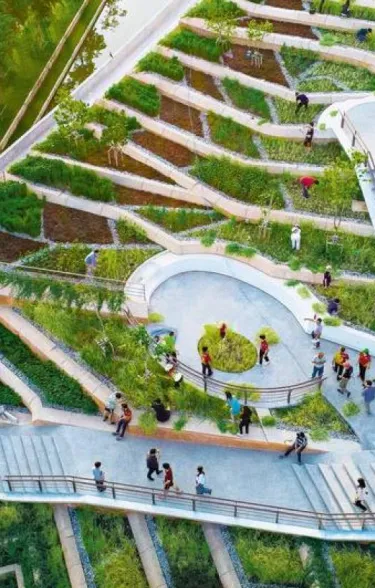
The main global challenge for the cement industry is to facilitate economic growth while reducing CO2 intensity within the built environment. This means reducing the carbon intensity of our own operations, innovating in products (with a full environmental life-cycle assessment of the products at the heart of that process), but also making sure that our products are used in a way that diminishes the energy intensity of a building over its whole life. This activity is what is often called Sustainable Construction. Recognising its vital importance it is an area in which Lafarge has set out to give a lead.
Promoting sustainable construction
Lafarge has set itself the objective to build a common vision on climate change and CO2 performance, together with other industries and cement players, but also with its stakeholders, such as WWF.
|
|